
The entry-level oscilloscope market has exploded with affordable options that put professional-grade test equipment within reach of hobbyists, students, and small repair shops.
🏷️ Oscilloscope Deals ⭐⭐⭐⭐
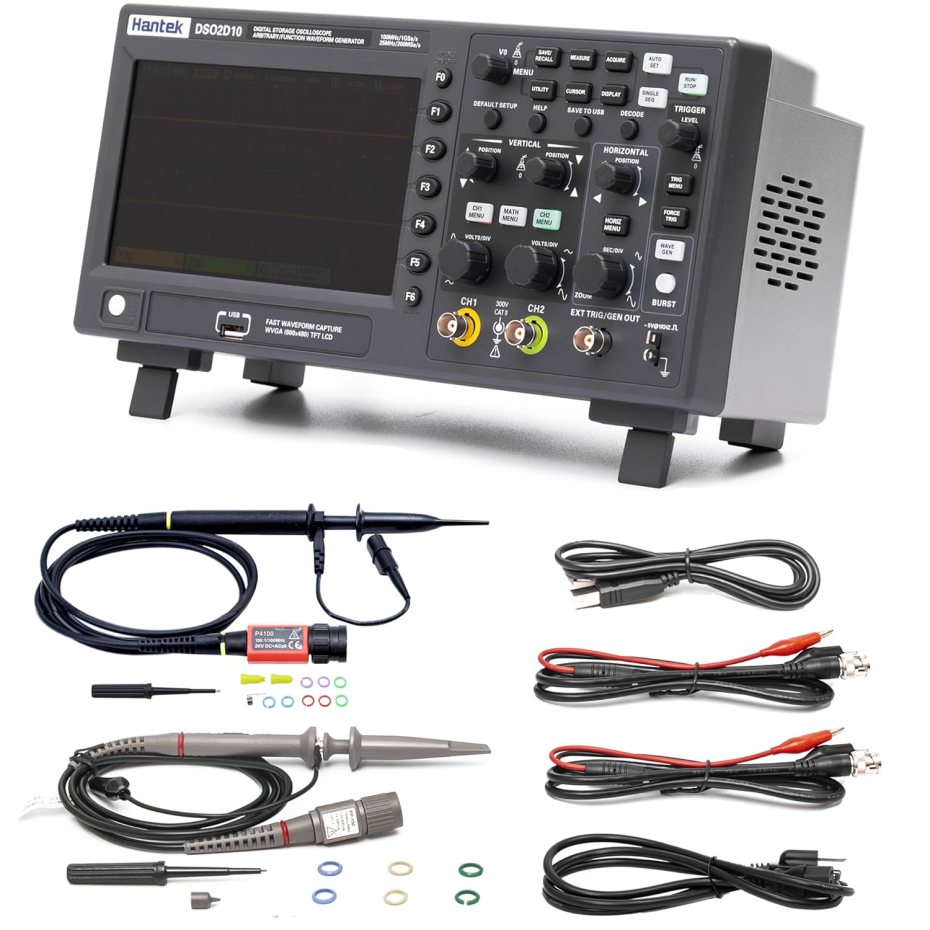
Two popular contenders, the FNIRSI 1014D and Hantek DSO2D10, both promise 100 MHz bandwidth, dual channels, and built-in signal generators for around $150–250. On paper they look similar, but in practice they target very different users.
Here’s the full breakdown.
Table of Contents
Comparison Table
| Feature | FNIRSI 1014D | Hantek DSO2D10 |
|---|---|---|
| 💳 Pricing | 💲Check Price | 💲Check Price |
| Bandwidth | 100 MHz | 100 MHz |
| Channels | 2 analog | 2 analog |
| Sampling Rate | 1 GSa/s | 1 GSa/s |
| Memory Depth | 240 Kbit | 8 Mpts |
| Display | 7″ 800×480 TFT | 7″ 800×480 WVGA |
| Weight | ~1.5 kg | 1.9 kg |
| Signal Generator | DDS, 14 waveforms, fixed 2.5 Vpp | 25 MHz AWG, adjustable amplitude |
| Protocol Decoding | None | UART, I²C, SPI, CAN, LIN |
| Trigger Types | Basic (5 types) | Advanced (14+ including serial) |
| Math Functions | Basic (+, −, ×, ÷, FFT) | Advanced (+, −, ×, ÷, FFT with windows) |
| Auto Measurements | Basic | 32 with statistics |
| DVM Function | No | Yes (dual 3-digit) |
| Frequency Counter | No | Yes (6-digit hardware) |
| PC Software | None (USB storage only) | Full remote control + analysis |
| Fanless Operation | No | Yes |
| Single Trigger Button | No | Yes |
| Power Supply Noise | Users report noise | Low noise |
| USB Connectivity | Storage only | USB host & device |
Design and Build Quality
The FNIRSI 1014D uses a compact, portable design with a 7-inch 800×480 touchscreen in a lightweight plastic enclosure. At around 1.5 kg, it’s genuinely portable and can run from USB power or a 12 V adapter. Controls consist of rubber buttons and multi-function rotary encoders that change behavior depending on on-screen menus. It’s clearly built as a functional tool rather than a refined instrument, and the plastic housing reflects that.

The Hantek DSO2D10 takes a more traditional benchtop approach. At 1.9 kg it’s still portable, but feels more substantial. The control layout mirrors classic oscilloscopes, with dedicated buttons and knobs that make operation intuitive. A standout feature is its fanless design, which keeps the unit completely silent, a real advantage in quiet workspaces.
Winner: Hantek DSO2D10. Better build quality, silent operation, and a more intuitive control layout
Core Specifications: Similar on Paper, Different in Reality
On paper, both scopes offer the same headline specs: 100 MHz bandwidth, two channels, and 1 GSa/s sampling. The real differentiator is memory depth. Hantek’s 8 Mpts buffer allows long captures at high sampling rates, while FNIRSI’s 240 Kbit memory fills up quickly.
Real-world testing also shows that both scopes struggle to deliver a true 100 MHz usable bandwidth. Effective performance tends to land closer to 30–50 MHz, which is typical in this price range. Both technically meet the −3 dB requirement at 100 MHz, but just barely.
Signal Generator Capabilities
The FNIRSI 1014D includes a DDS signal generator with 14 standard waveforms and arbitrary waveform output. Its novelty feature is waveform “chopping”, letting you capture a signal and replay it through the generator. Unfortunately, the output voltage is fixed at 2.5 Vpp and cannot be adjusted, severely limiting real-world usefulness.
The Hantek DSO2D10 includes a 25 MHz AWG with adjustable amplitude and frequency. While less flashy, it’s far more practical for injecting signals into real circuits at appropriate voltage levels.
Winner: Hantek DSO2D10. Adjustable output voltage makes all the difference

Triggering and Protocol Analysis
FNIRSI provides basic triggering options suitable for simple signals but lacks advanced trigger modes and, critically, does not include a dedicated Single trigger button. Capturing one-shot events can be frustrating.
Hantek excels here, offering a wide range of trigger types plus built-in serial protocol decoding and triggering for UART, I²C, SPI, CAN, and LIN. This dramatically improves usability for embedded and automotive work.
Winner: Hantek DSO2D10 by a wide margin.
Measurement and Analysis Tools
Both scopes offer cursor measurements, automatic readings, FFT, and math functions. FNIRSI’s FFT is usable but basic. Hantek adds statistical measurements, dual digital voltmeters, and a hardware frequency counter, which are genuinely useful in daily troubleshooting.
Winner: Hantek DSO2D10
Software and PC Connectivity
FNIRSI connects over USB as mass storage, allowing easy screenshot and waveform transfer without drivers. However, there is no remote control or analysis software.
Hantek includes full PC software for remote operation and waveform analysis, plus SCPI support for automation. You can effectively run the oscilloscope from your PC, which greatly extends its usefulness.
Winner: Hantek DSO2D10
Price and Value
FNIRSI undercuts Hantek by roughly $40–50, making it attractive to beginners or those on a strict budget. Hantek costs more, but the additional features, especially protocol decoding and memory depth, often justify the price difference.
Winner: Depends on budget and use case.
What Actual Users Think
User feedback across forums and reviews is consistent. FNIRSI is widely seen as acceptable for basic waveform viewing but compromised in several key areas, particularly the fixed-voltage signal generator and noisy power supply.
Hantek is praised for its protocol decoding, silent operation, deeper memory, and more professional feel. For microcontroller and digital work, users overwhelmingly recommend the DSO2D10 despite the higher price.
Recommendations
Choose FNIRSI 1014D if:
- Budget is extremely tight
- You need maximum portability
- You only work with simple analog signals
- Fixed 2.5 V signal output is acceptable
- You’re learning oscilloscope basics
Choose Hantek DSO2D10 if:
- You work with microcontrollers or serial buses
- Protocol decoding matters
- Adjustable signal generation is important
- Silent operation is a priority
- You want PC control and deeper analysis tools
- You plan to grow into more advanced projects
Final Verdict
The FNIRSI 1014D is a functional entry-level scope that works for simple tasks, but it comes with real compromises. The Hantek DSO2D10 costs a little more, yet delivers features that genuinely improve productivity and longevity.
If you expect to debug digital buses, analyze longer signals, or grow beyond beginner-level electronics, the Hantek is the smarter long-term investment. The FNIRSI can get you started, but most users will outgrow it quickly.
