
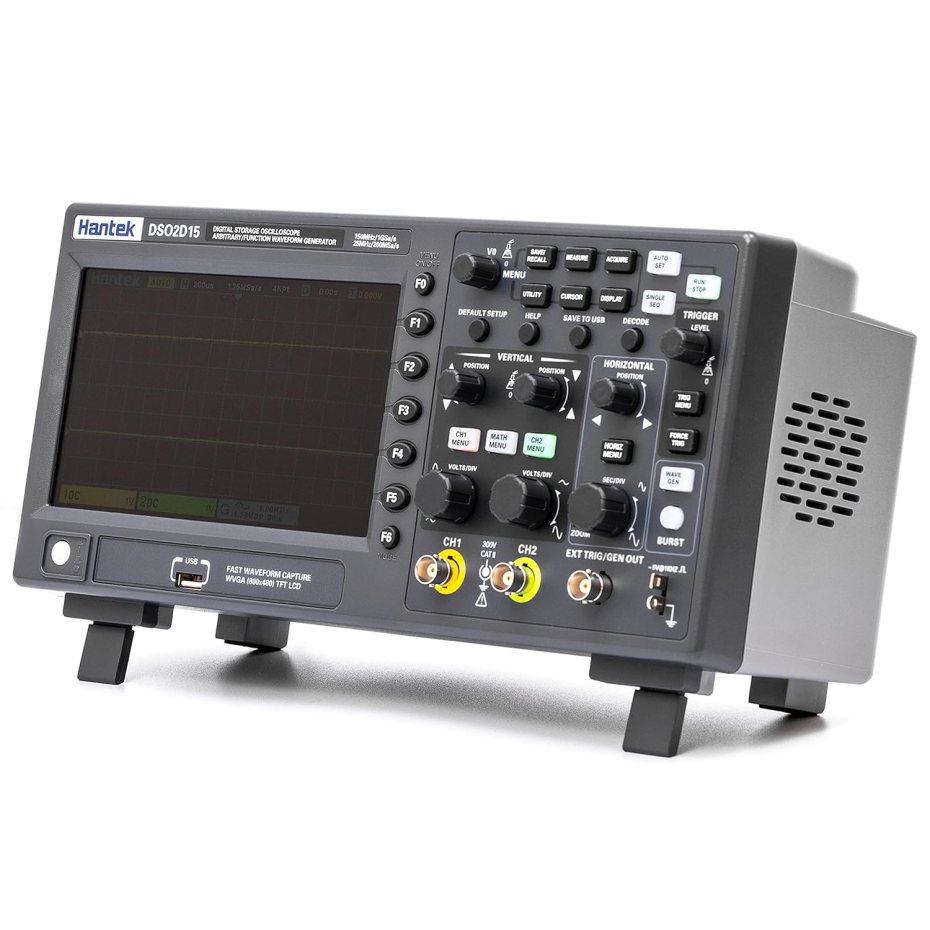
Choosing between Hantek’s DSO2C10 and DSO2D15 isn’t just about bandwidth, it’s about deciding whether you need two crucial upgrades: higher frequency capability and an integrated signal generator.
🏷️ Oscilloscope Deals ⭐⭐⭐⭐
These models sit at opposite ends of the DSO2000 lineup, offering very different value propositions despite sharing the same core platform. Here’s a clear, practical breakdown to help you choose.
Table of Contents
Comparison Table
| Feature | DSO2C10 | DSO2D15 |
|---|---|---|
| 💳 Pricing | 💲Check Price | 💲Check Price |
| Bandwidth | 100 MHz | 150 MHz |
| Built-in AWG | ❌ No | ✅ Yes (25 MHz) |
| Channels | 2 analog | 2 analog |
| Sampling Rate | 1 GSa/s | 1 GSa/s |
| Memory Depth | 8 Mpts | 8 Mpts |
| Display | 7″ 800×480 WVGA | 7″ 800×480 WVGA |
| Protocol Decoding | ✅ I2C, SPI, UART, CAN, LIN | ✅ I2C, SPI, UART, CAN, LIN |
| Trigger Types | 14 types | 14 types |
| Auto Measurements | 32 with statistics | 32 with statistics |
| DVM Function | ✅ Dual 3-digit | ✅ Dual 3-digit |
| Frequency Counter | ✅ 6-digit hardware | ✅ 6-digit hardware |
| PC Software | ✅ Full remote control | ✅ Full remote control |
| Fanless | ✅ Yes | ✅ Yes |
| Weight | 1.9 kg | 1.9 kg |
| Best For | Budget-conscious, <50 MHz work | Higher frequencies, need generator |
The Two Key Differences
Bandwidth, 100 MHz vs 150 MHz
Using the standard 1:5 bandwidth rule, the DSO2C10 comfortably measures signals up to about 20 MHz with good accuracy, while the DSO2D15 extends that to roughly 30 MHz. For hobbyist and repair work, Arduino, Raspberry Pi, audio circuits, power supplies, 100 MHz is more than enough. The 150 MHz option becomes valuable for faster digital buses, higher-speed microcontrollers, RF experimentation, and switch-mode power supplies operating well above 50 MHz.
Signal Generator, None vs 25 MHz AWG
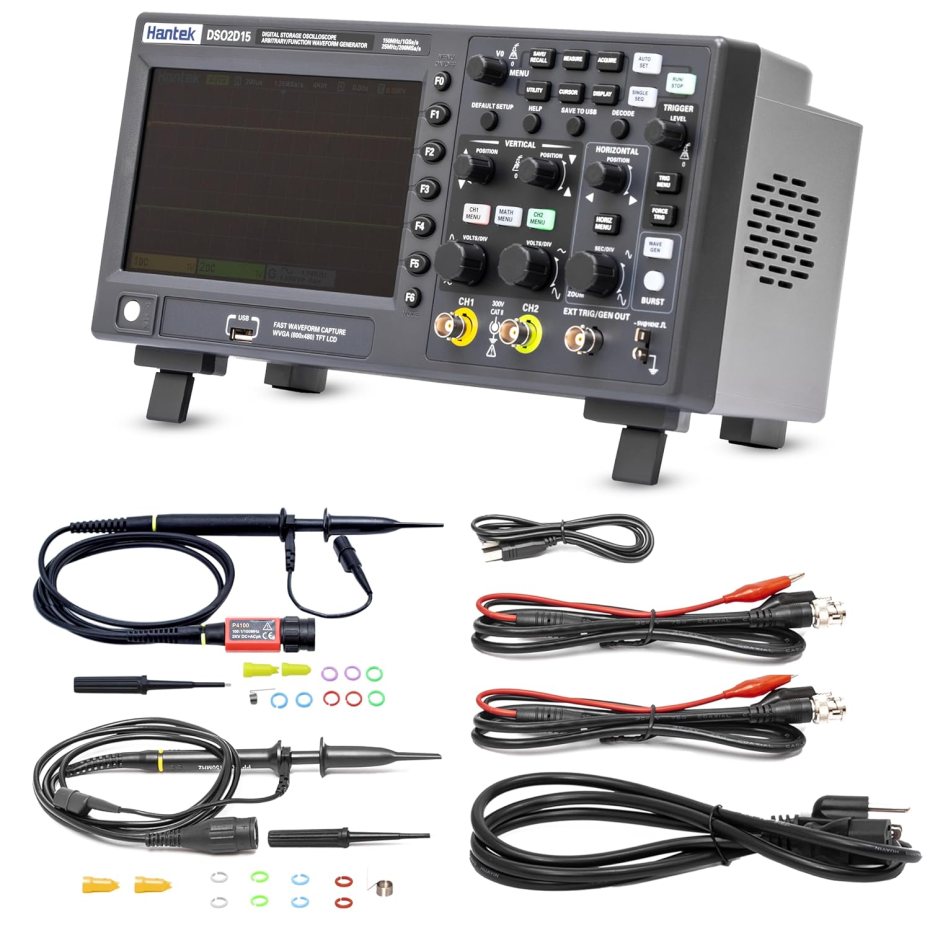
The DSO2D15 includes a 25 MHz arbitrary waveform generator with adjustable frequency and amplitude. This turns it into a genuine 2-in-1 instrument, saving both bench space and the cost of a separate function generator. The DSO2C10 is oscilloscope-only, meaning any signal injection or stimulus testing requires additional equipment.

Shared Strengths: The DSO2000 Platform
Both models are built on the same solid DSO2000 foundation.
Protocol Decoding
I2C, SPI, UART/RS232, CAN, and LIN decoding and triggering are included on both models, features often reserved for much more expensive scopes. For embedded and microcontroller work, this alone is a major selling point.
Software Suite
The DSO2000 PC software allows full remote control, FFT and XY display, waveform capture, and automation via SCPI commands. Arbitrary waveform editing is available for models with AWG support.
Build Quality and Interface
Fanless operation keeps the scopes silent. The traditional knob-and-button layout feels familiar and professional, and the 7-inch display is clear and readable.
Measurement Tools
You get 32 automatic measurements with statistics, dual digital voltmeters, a 6-digit hardware frequency counter, and FFT analysis with multiple windowing options.
Decision Framework
Choose DSO2C10 if:
- Your work stays well under 50 MHz (Arduino, audio, basic digital)
- You already own a function generator
- Your budget tops out around $200
- You prefer a scope-only, dedicated-instrument setup
- You’re learning fundamentals and don’t need higher speeds yet
Choose DSO2D15 if:
- You work with faster digital circuits or RF-related signals
- You don’t own a function generator
- You want a compact 2-in-1 solution
- You want headroom for future projects
- You can comfortably afford the higher price
- You troubleshoot switch-mode power supplies or high-speed logic
The middle ground
If you want the signal generator but don’t need the extra bandwidth, the DSO2D10 (100 MHz + AWG) is often the sweet spot at roughly $220–280.
Real-World Bandwidth Considerations
A quick reality check: like most budget oscilloscopes, the headline bandwidth numbers are optimistic.
- The DSO2C10’s 100 MHz behaves more like 70–80 MHz in practice
- The DSO2D15’s 150 MHz behaves closer to 100–120 MHz
This is normal for entry-level scopes and doesn’t diminish their usefulness, but it’s worth setting expectations accordingly.
What Actual Users Think
Forum discussions show a consistent pattern. Users choosing their first scope often debate future-proofing versus cost, and those who stretch for the higher model rarely regret it. Many who start with the DSO2C10 later wish they had bought a “D” model once they realize how useful an integrated generator can be.
Reviews also consistently praise the DSO2000 platform for sharing internals with higher-tier Hantek models, delivering strong protocol decoding, deep memory, and reliable PC software at a lower price point.
The recurring theme is simple: users rarely regret buying more capability, but often regret outgrowing a cheaper option.
Recommendations
For students and beginners
The DSO2C10 is an excellent learning tool. It covers everything encountered in typical coursework and entry-level projects, leaving budget for other essentials like a power supply or multimeter.
For home labs and hobbyists
The DSO2D10 or DSO2D15 makes more sense. Integrated signal generation is genuinely useful, even if you don’t realize it at first.
For repair shops and technicians
The DSO2D15 offers flexibility and convenience. The extra bandwidth handles a wider range of equipment, and the built-in generator reduces the need for multiple instruments.
For embedded systems developers
Either model works well thanks to protocol decoding. Choose based on clock speeds and signal edges. Slower MCUs are fine on the DSO2C10; faster ARM-based systems benefit from the DSO2D15.
For RF and high-speed digital work
The DSO2D15 is the minimum sensible choice. Even then, very serious RF work may eventually require a higher-tier instrument.
The Verdict
The DSO2C10 is a strong budget oscilloscope for users who truly stay below 40–50 MHz and already have a signal generator. It delivers professional features at an unusually low price.
For most users, though, the DSO2D15 is the better long-term investment. The additional bandwidth provides meaningful headroom, and the integrated AWG adds everyday utility that easily justifies the $100–130 premium.
Best value pick overall: the DSO2D10, which splits the difference by offering the signal generator without paying for bandwidth you may never need.
Bottom line
If you’re absolutely certain your work stays slow and simple, the DSO2C10 saves money without serious compromise. If there’s any doubt at all, or if you lack a function generator, the DSO2D15 is the safer, more future-proof choice.
