When choosing or using an oscilloscope, you’ll often encounter the term “memory depth.” While features like bandwidth and sample rate get a lot of attention, memory depth plays an important role in how well an oscilloscope captures and displays signals.
🏷️ Oscilloscope Deals⭐⭐⭐⭐⭐
So, what exactly is oscilloscope memory depth, and why should you care? This article breaks down the concept in simple terms, explains why it matters, and helps you understand how it impacts signal analysis.
Table of Contents
What is Oscilloscope Memory Depth?
Memory depth refers to the amount of data an oscilloscope can store when capturing a signal. It determines how long and how detailed the recorded waveform will be.
Think of memory depth like the storage capacity of a camera:
- More memory = more high-resolution photos (or longer, detailed signal captures).
- Less memory = fewer or shorter recordings before storage fills up.
In oscilloscopes, memory depth is measured in points (e.g., 1M points, 10M points, or 100M points), where each point represents a single sample of the signal.
How Does Memory Depth Work?
When you capture a signal:
- The oscilloscope samples the signal at a certain sample rate (e.g., 1 GSa/s, meaning 1 billion samples per second).
- Each sample is stored in memory as a data point.
- Memory depth limits how many points the scope can store during one capture.
Example
- With 1M points of memory at a sample rate of 1 GSa/s, you can capture 1 millisecond of data.
- With 10M points at the same sample rate, you can capture 10 milliseconds of data—10 times longer!

Why is Memory Depth Important?
🕒 Longer Capture Times at High Sample Rates
High sample rates provide better detail, but they use up memory faster. A deeper memory lets you maintain a high sample rate over a longer time.
Why it matters:
- Capture long signals without losing detail.
- Essential for troubleshooting intermittent glitches that occur over time.
🔍 Better Resolution Over Longer Periods
Without enough memory, the oscilloscope reduces the sample rate to capture longer signals, which loses detail.
More memory = clear waveforms even when you’re zoomed out.
⚡ Accurate Analysis of Fast, Complex Signals
High-frequency or digital communication signals (like USB, HDMI, or Wi-Fi) require deep memory to capture their fast transitions and long data sequences.
Shallow memory may miss important signal details or timing errors.
How Memory Depth, Sample Rate, and Time Base Work Together
These three factors are connected:
🕒 Time Base: How much time is shown across the screen.
📊 Sample Rate: How many data points are collected per second.
💾 Memory Depth: How many data points the oscilloscope can store.
✅ Formula:
Capture Time = Memory Depth ÷ Sample Rate
Example:
- Memory depth: 10M points
- Sample rate: 1 GSa/s
- Capture time = 10M ÷ 1G = 0.01 seconds (10 ms)
More memory means longer captures without sacrificing detail!
Shallow vs. Deep Memory
| Feature | Shallow Memory (e.g., 1M points) | Deep Memory (e.g., 100M points) |
|---|---|---|
| Capture Duration | Short | Long |
| Signal Detail | Limited at long time bases | High detail over extended captures |
| Zoom Capability | Low (blurry when zoomed in) | High (clear when zoomed in) |
| Use Case | Simple signals, basic troubleshooting | Complex signals, protocol analysis |
Memory Depth of Different Oscilloscopes
| Oscilloscope Model | Bandwidth | Memory Depth |
|---|---|---|
| Rigol DS1202Z-E | 200 MHz | 24 Mpts (million points) |
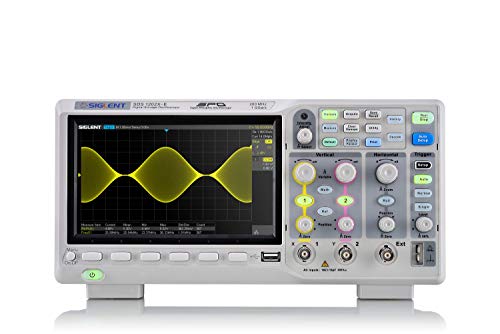
| Siglent SDS1202X-E | 200 MHz | 14 Mpts (million points) |
| PicoScope 5000 Series | Up to 200 MHz | Up to 512 MS (million samples) |
| Hantek DSO5102P | 100 MHz | 40 Kpts (thousand points) |
| DSO2512G | 120 MHz | Limited (approx. 4 Kpts) |

When Do You Need Deep Memory?
✔ Use Cases for Deep Memory:
- Capturing long data streams (USB, Ethernet, or CAN bus signals)
- Finding rare glitches in a long signal capture
- Analyzing signals with varying frequencies
- Zooming in on a specific event without losing detail
✔ When Shallow Memory is Enough:
- Simple sine waves or basic circuit testing
- Quick checks without needing long captures
- Low-frequency signals with no fine detail required
Tips for Using Oscilloscope Memory Efficiently
💡 Use Segmented Memory (If Available): Capture only relevant signal parts and skip idle times to save memory.
💡Adjust Sample Rates Wisely: Lower the sample rate for long-duration captures if fine detail isn’t needed.
💡 Use Triggers Effectively: Trigger on specific events to avoid wasting memory on unnecessary data.
Final Thoughts
Memory depth in an oscilloscope is like the fuel tank of a car—the bigger it is, the longer you can go without sacrificing performance. With deep memory, you can capture long signals at high resolution, making it easier to zoom in on details and spot hidden glitches.
If you’re working with complex digital signals, performing in-depth analysis, or dealing with intermittent issues, investing in an oscilloscope with more memory is a smart choice.
